XXI: Pew-Pew!

Lest you conclude that this blog consists solely of droll erudite pedantry, we offer the following...
From recent posts, one might suspect that The Collection contains nothing but dusty old books and heavily-foxed prints, but that would be wholly inaccurate. It also includes dusty old toys (amongst other dusty old things). So, en hommage to The Pythons- now for something completely different.
In this post, we’ll be looking at The Archive’s collection of American Mid-Century space-themed target toys. In so doing, we’ll be approaching them as works of graphic design, rather than as playthings. You will also undoubtedly be delighted to read that this method will limit the amount of textual scholarship presented with each piece, although your humble Archivist shall do his best to overcomplicate things nonetheless...
Having spent quite some time in the Colonies, I can assure you that, along with Mom and Apple Pie, a key component of American culture pertains to guns. And shooting things with them. This is, of course, reflected in their toys as well. During the 1930s through the 1950s, cowboy Westerns dominated the popular toy culture, and tots were encouraged to shoot bad guys with “six-shooters”. As science fiction and the Space Race became more dominant in the American psyche, little ones graduated to shooting space aliens, spaceships, and even entire planets. Whereas before, children were provided with toy guns and whatever their imaginations might concoct for targets, space-themed shooting toys tended to come with their own targets, many of which were produced on lithographed tin. Ah, progress...
On target
Whilst there are several books published (and, of course, held in The Collection) about toy ray guns, there are none, to your Archivist’s knowledge, devoted exclusively to space-themed target toys (aspiring authors in the audience, take note). This post seeks to remedy this lacuna in the annals of popular culture. Targets in The Collection range in style from flat design to the painterly. Many also include representations of “space cities” that are magnificent amalgamations of Art Deco and Machine Age architectural design. Scoring on tin targets was usually accomplished with suction cup or magnetic-tipped darts. Fiberboard targets were scored with their sharper cousins. And if you’re seeking astronomical accuracy, it is suggested that you venture elsewhere.
Space Target. c. 1940s Lithographed tin with cardboard backing. Manufacturer Unknown. About 36 x 58 cm.
This is the earliest piece in The Collection and is unique in that its iconography is character-driven. Likely influenced by such comic strip and serial stars as Flash Gordon and Buck Rogers, the target depicts fisticuffs between an Earthman and an alien in the foreground. A large sunspot in the midground contains five villainous cameos. At least with this one, you know at whom you’re shooting.

Rocket Patrol Magnetic Target Game. 1950s (?). Lithographed tin. American Toy Products, Beverly, MA. About 39 x 34 cm.
Included in this target amongst the standard planets are the moons Phobos and Deimos as well as the asteroid Vesta and Halley’s Comet. Learn astronomy whilst improving your marksmanship!
“My God, it’s full of stars!”.

Rockets Away. 1952. Paper on pressboard backing. Amsco (American Metal Specialties Co.). Hatboro, PA. About 38 x 38 cm.
While most targets stood upright for horizontal shooting by dart guns, attacking this target was accomplished by dropping bombs vertically. In this game, very sharp metal-tipped darts were dropped onto the target using a “rocket launcher” (i.e., cardboard box). The absence of scoring numbers yields a clean futuristic cityscape rendered in primary colors.

What could go wrong?

The ordiannce delivy device (a cardobord box)

Space Target. c. 1950 (?). Lithograph tin with cardboard backing. Superior Toy Company. About 38 x 59 cm.
Here a decidedly Art Deco style target includes a rocket launching pad and a crowded sky of spaceships, jets, and saucers. A space traffic controller’s nightmare.

Outer Space Target Game. 1950s (?). Lithograph tin. Louis Marx & Co., New York. About 33 x 65 cm.
To play this game, would-be world destroyers used a spring-loaded plastic launcher to rain down radioactive death. But be careful, this target includes negative points for collateral damage.

Pre-hypersonic techology.

Cosmic Gun Sight. 1957. Lithographed tin. About 8 cm diameter.
This cosmic gun sight was one of eight gauges that could be collected from boxes of Kix cereal, back when cartons of sugar contained rewards to offset the inevitable dental bills. Only dials were provided; they included a “meteor radar warning” and a “space altimeter”. The rest, such as the creation of a spaceship (likely cardboard) and targets (nearby siblings and pets) were left to the imagination.

Champion Space Race Target Game. 1960s. Printed paper on fiberboard backing. Unknown Manufacturer. About 45 x 45 cm.
In this paper target, the rotational rings of planetary motion are depicted, even if the order of the planets somewhere between Copernican and Ptolemaic.

Rex Mars Planet Patrol. 1950s (?). Lithographed tin and plastic. Marx Toy. Target about 34 x 14 cm.
Unable to get the licensing for Flash Gordon or Buck Rogers, Marx created their own space hero, Rex Mars. This target features plastic aliens and robots that spin when hit. Several of these figures also appear in Marx’s Rex Mars playset as small figures.

The tin lithography bracketing the figures depict magnificent space metropolises.

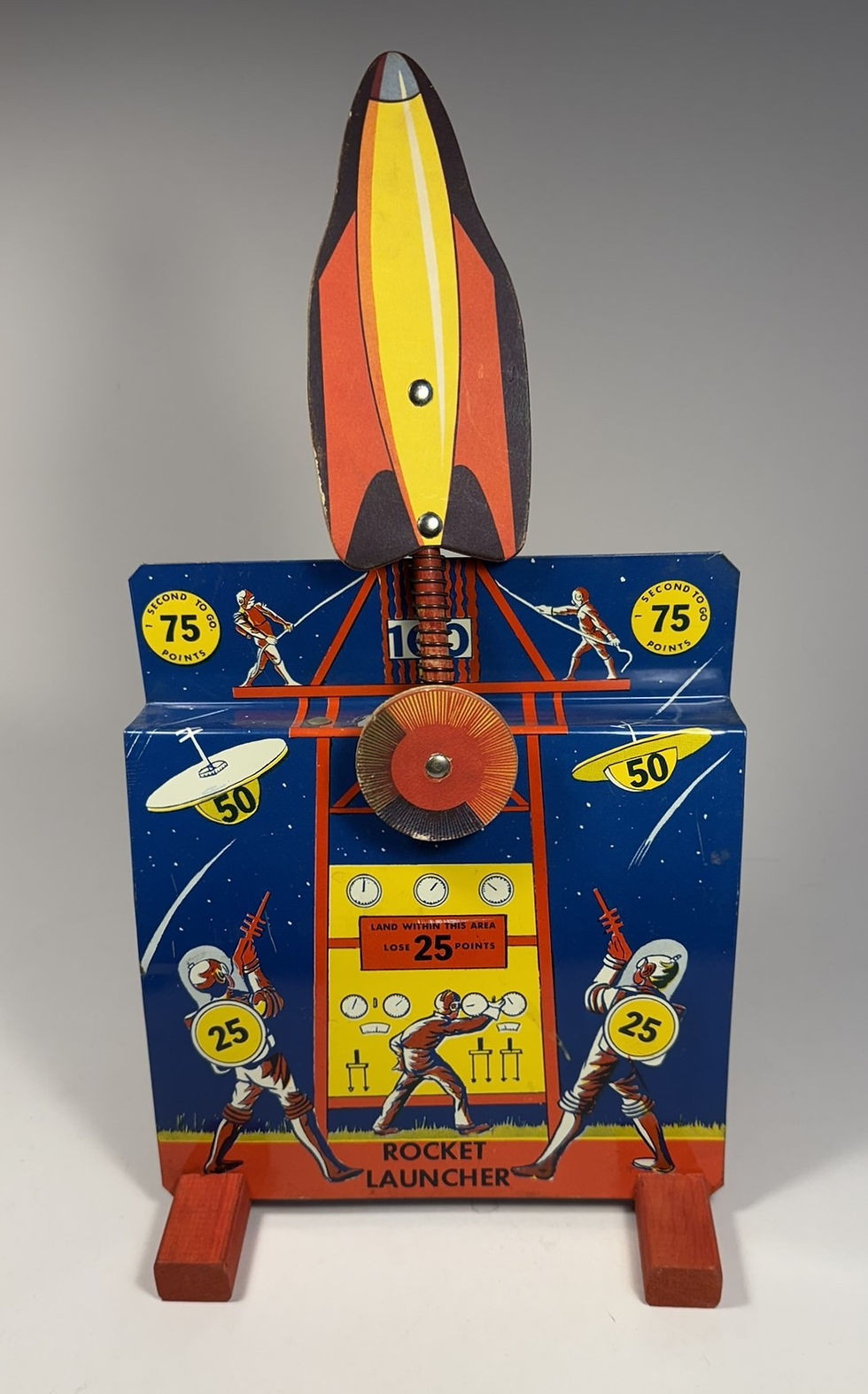
Rocket Launchers. 1950s (?). Lithographed tin. American Toys. Target about 38 x 28 cm. (without rockets).
This game depicts the inner workings of a rocket launching station and adds the novelty of spring-loaded rockets that launch when properly targeted. A center rocket, labeled a “dud” merely falls over when hit.

Rocket Launchers (small version). 1950s (?). Lithographed tin. American Toys. Target about 20 x 23 cm. (without rockets).
American Toys also issued a smaller version of their Rocket Launchers game, with a single spring loaded rocket.
Marksman Space Target. c. 1950s. Lithographed tin. Moonglow Plastic Jewel Corp., Selco Division, New York, NY. About 32 x 38 cm.
Against a backdrop of atmospheric levels emanating from earth’s surface are depicted various planets and spaceships. Wildly out of scale, the text beneath each planet states its distance from earth, so, there’s that.

Space Acuity Game. c. 1950s. Lithographed tin. A&A American Metal Toy Co. Brooklyn, NY. About 13 x 9 cm.
This dexterity game is played by trying to get steel balls to stay in holes distributed across the game. The play surface features wonderful space architecture, complete with firing defensive cannons and explosions.

Satellite Patrol. 1960s (?). Lithograph paper applied to cardboard backing. Harett-Gilmar, Inc. Far Rockaway, NY. About 33 x 33 cm.
In this cardboard target, an astronaut’s head and a sputnik style satellite are manually sent spinning around the earth to increase the difficulty of hitting them with rubber-tipped darts.

A-OK Space Race Game. 1962. Fiberboard, metal, and plastic. Play Patterns by Paige. About 19 x 25 cm.
This game stands out with its three-dimensional armillary sphere consisting of rings of celestial circles in primary colors. Players launched small magnetic weights at the play area in an attempt to get them to attach to central globe.

Space Captain. 1960s (?). Lithograph tin. Pressman Toy Corp. New York, NY. About 34 x 44 cm.
This tin litho target presents the play from the unique perspective of looking outside the port of a rocket ship, with a foreboding background that includes “negative space warp” and “contra-terrene matter”. Jeez!

Space Target. 1960s (?).
Lithograph tin. Sidney H. Tarrson, Co. Chicago, IL. About 31 x 31 cm.
With a distinctly 60s palette, this target presents pink and green targets(which include an anthropomorphic moon) against a white background.

Wham-O Blaster and Alien Targets. c. 1966 (?). Plastic and metal blaster, printed paper targets. Wham-O. Targets about 10 x 12 cm. each.
These paper targets were accompanied by the famed Wham-O air blaster, which used compressed air to knock over light objects and terrify household pets.
You’ll shoot your ear out, kid!

All fun and kawai until you see the blasters in their hands...

Cyclops Monster. 1966. Lithographed cardboard. Lost in Space Playset. Mattel Corporation. About 15 x 26 cm.
This cardboard target was part of a Switch’n’Go playset based on the TV series Lost in Space. The set included a battery powered space chariot that fired plastic missiles. While the episode in which the cyclops appeared ("There Were Giants in the Earth") was broadcast in black and white, the target is rendered in hues of pink and orange; hey it was the Sixties, man!

I do hope that you enjoyed our Midcentury astro-futurist excursion into space (no “-X” required). Please come back again to see what’s next. I can assure you only that it will be different (except, alas, for the incessant rambling, sardonic commentary which appears to be inescapable).
Thank you for visiting.
Most sincerely yours,
le Compte Paul Gregoire de Gustibus


Comments